• Skip to primary navigation
  • Skip to main content
  • Skip to primary sidebar

QTOOTH

News & Reviews for Living with Bluetooth Wireless

  • Reviews
    • Wearable
    • Gaming
    • Health & Fitness
    • Home & Office
  • How To Tips
  • Industry News
  • About QTOOTH

Tech Talk

Wireless Service for 30 New Underground Subway Stations

2013-06-24

nyc-skyline-qtoothTransit Wireless and the Metropolitan Transportation Authority (MTA)  announced a significant milestone in the multi-year project to build a state of the art wireless network in the New York City subway system. Thirty new subway stations in mid-town Manhattan, including Times Square, Rockefeller Center, Lincoln Center and Columbus Circle are now online, in addition to the initial six in Chelsea, which went online in September 2011.

MTA officials were joined by executives from Transit Wireless, AT&T, T-Mobile USA and Boingo Wireless to demonstrate the service at the Times Square Station.

In addition, representatives from Sprint and Verizon Wireless were also on hand to announce that both carriers are finalizing agreements to participate in the network, meaning that all four major carriers are expected to provide cell phone and data connectivity to their customers in New York’s underground subway stations.

“For the past three years, the MTA has been on a clearly defined mission to bring our mass transit system into the 21st century with upgrades to the station environment through several ambitious new-technology communications projects like this one, aimed at improving the travel experiences of our customers while offering another level of security,” said MTA Interim Executive Director Thomas F. Prendergast.”

“The New York City subway system is the most heavily trafficked system in the world and now riders have wireless service. We have been working closely with AT&T, T-Mobile USA and Boingo to bring wireless technology into one of the oldest and historic public transportation systems in the world and we’re thrilled to begin that work with Sprint and Verizon,” said William A. Bayne Jr., CEO of Transit Wireless, “This network benefits not only riders, but city workers and first responders, and it will be the backbone for future technology and safety improvements to the city’s subway stations.”

Public Safety Benefits

grand-central-qtoothWhile the network allows users to make and receive cell phone calls, send text messages, stream music, play online mobile games and more, all from underground subway station, it also enables important services that improve security such as E911 that allow dispatchers to know when a call is being placed from an underground platform and the forthcoming Help Point Intercom system, which will help riders get basic travel information or get help in an emergency with the push of a button, right on the platform.

“This goes beyond providing cell service underground, it brings our customers a new level of security – with the ability to dial 911 in an emergency,” said Acting MTA Chairman Fernando Ferrer. “Customers now know that when they see something, they can now say something using their device to call 911.”

Leading Wireless Providers Continue Partnership

Under agreements with the MTA and Transit Wireless, AT&T and T-Mobile USA customers can now use their cell phones to make and receive calls as well as use wireless data in more underground subway stations. Service should be available for Sprint and Verizon customers later this year.

“Bringing wireless to these busy subway platforms helps AT&T deliver on its commitment to provide our customers with the fastest and most reliable wireless service in New York City, including 4G LTE, whether above or below ground, at home, at work or in between,” said Tom DeVito, AT&T’s vice president and general manager for New York and New Jersey. “This initiative will also help spur transit innovation, which is one of the reasons AT&T is working with the MTA and NYU Poly on the AppQuest Challenge to develop the next generation of transit apps to improve the experience of every commuter.”

“Through this project, T-Mobile is extending our blazing fast nationwide 4G network coverage into the New York City subway, where New Yorkers often spend a significant part of the day,” said Tom Ellefson, regional vice president, Engineering and Operations at T-Mobile USA. “Our customers have really embraced the unlimited 4G experience T-Mobile offers, and now they can keep browsing, streaming and sharing when they go underground. We expect to launch 4G LTE in New York this summer, and this project has paved the way for it to extend into the subway as well.”

“Boingo has kept commuters connected since our managed and operated services launched in 2011. We look forward to expanding our network and introducing leading brands to consumers at stations across the city,” said Zack Sterngold, vice president of business development at Boingo Wireless. “Boingo’s advertising and sponsorship platform allows commuters to connect to subway Wi-Fi free-of-charge, and enables advertisers to reach the on-the-go, connected New Yorkers with location-based messages.”

Subway riders can currently access the sponsored Wi-Fi network provided by Boingo for free by choosing the SSID: FreeWifibyHTCONE.

“In the city that never sleeps, New Yorkers love to use their mobile devices 24/7 to stay connected to friends, loved ones and business associates. So, we are thrilled to include the subway in the buildout of our new network and deliver the robust benefits of 3G and 4G LTE to commuters, public safety representatives and first responders,” said Greg O’Connor, vice president of engineering at Sprint.

“Verizon Wireless is always exploring opportunities to provide our customers with the world-class experience of the nation’s largest 4G LTE network and most reliable 3G network, no matter where they are – above ground or below. In addition to the more than $3 billion that we’ve already invested in the Verizon Wireless network regionally, we’re working with Transit Wireless to finalize an agreement to bring Verizon Wireless service to 76 stations as we support the current and next phase of this project,” said Patrick Devlin, regional president for Verizon Wireless.

The list of stations now connected is as follows (* first six were part of the initial build):

*123 Street – 8 Ave.CE
*214 Street – 8 Ave.ACE
*314 Street – 7 Ave.123
*414 Street – 6 Ave.FM
*514 Street – 8 Ave.L
*614 Street – 6 Ave.L
796 StreetBC
886 StreetBC
928 Street1
1018 Street1
1181 Street-Museum of Natural HistoryBC
1272 StreetBC
1379 Street1
1423 Street1
1596 Street123
1666 Street-Lincoln Center1
1772 Street123
1857 StreetF
1947-50 Streets-Rockefeller CenterBDFM
2057 Street-7 Ave.NQR
2128 StreetNR
2250 Street1
2350 StreetCE
2423 StreetNR
2549 StreetNR
265 Ave.-53 StreetEM
2759 Street-Columbus Circle1
2859 St-Columbus CircleABCD
297 Ave.BDE
30Times Square-42 Street123
31Times Square-42 StreetNQR
32Times Square-42 Street7
33Times Square-42 StreetACE
34Times Square-42 StreetS
355 Ave.-59 StreetNR
3686 Street1


To quickly find stations that have wireless service, Transit Wireless today released a mobile-friendly website, available now at www.nycsubwaywireless.com.

Transit Wireless plans to outfit the remaining 241 underground stations within four years and has already begun work on the next 40 stations, which include Grand Central Station, 34th St. Herald Square and Bryant Park in mid-town Manhattan and stations throughout the Borough of Queens.

[amzn_product_inline asin=’B007OZNZG0′]

[amzn_product_inline asin=’B0083PWAPW’]

[amzn_product_inline asin=’B0051QVESA’]

Filed Under: Featured Content, Mobile, News, Tech Talk, Transportation

DIY Headphone Implant – Yes, Implant

2013-06-23

DIY Headphone Implant - QTOOTHSo here’s a bit of news from the human evolution frontier. Grinders, also known as biohackers, are people who identify with transhumanist and biopunk ideologies. Transhumanism is the belief that it is both possible and desirable to so fundamentally alter the human condition through the use of technologies as to inaugurate a superior post-human being. Sounds extreme? Maybe, maybe not. Think heart pacemakers or sub-dermal blood sugar management for diabetics. There are many examples of where modifying the human body is already routine. However, it is probably the DIY aspect of this following story that may make people ask, “Really?” Enjoy!

DIY Headphone Implant

By: Rich Lee
Published: June 24, 2013

This idea was completely inspired by @Saumanahaii ’s thread here:
http://discuss.biohack.me/discussion/252/subdermal-bone-conduction-headphoness#Item_32

First, the idea is based on this:
http://www.instructables.com/id/Make-Your-Invisible-Earphones/

The project is set up like this:
1. implant magnets
2. test implants with coil to make sure audio is picked up
3. implant coil/other parts w/transdermal jack & power charger

Having stuff like this done isn’t really the realm of doctors. Most Grinders rely on body modification artists to install their implants. I’ve had work done by the body modification master Steve Haworth in the past and have relied on him for advice on several project ideas. Steve instinctively knew the best way to go about the implantation in a way that would minimize chances for infection and would leave no scarring. The implant procedure itself went very smoothly and the pain was surprisingly minimal.

The first thing everyone asks is “why would you do this?” Honestly, I don’t feel the need to answer this question. People either get it or they don’t. I’m a Grinder, and we are notorious for getting it.

The second question is usually “what are you going to do with it?”

Listening to music is nice and probably the most obvious answer, but I intend to do some very creative things with it. The implant itself is completely undetectable to the naked eye. The device & coil necklace are are easily concealed under my shirt so nobody can really see it. I can see myself using it with the gps on my smartphone to navigate city streets on foot. I plan to hook it up to a directional mic of some sort (possibly disguised as a shirt button or something) so I can hear conversations across a room. Having a mic hooked up to it and routed through my phone would be handy. You could use a simple voice stress analysis app to detect when people might be lying to you. Not to say that is a hard science, but I’m sure it could come in handy at the poker table or to pre-screen business clients. I have a contact mic that allows you to hear through walls. That might be my next implant actually.

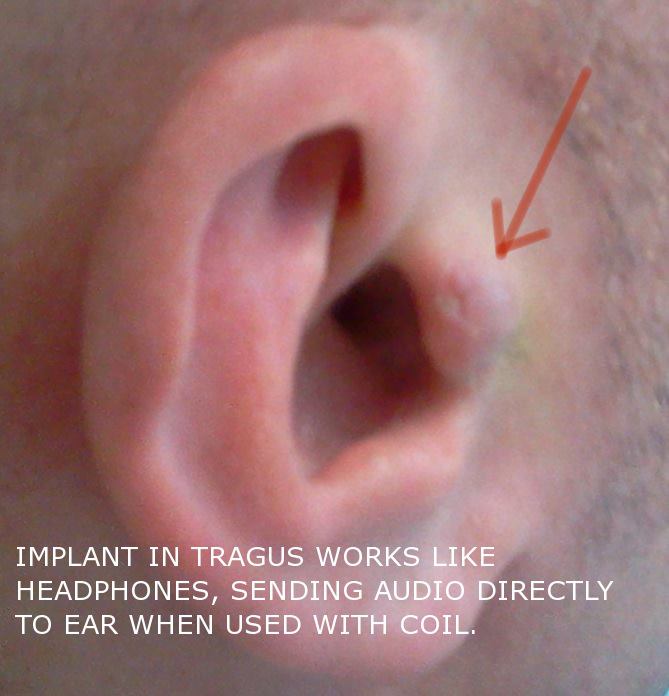
Tragus Headphone Implant - QTOOTH

I plan to hook this thing up to an ultrasonic rangefinder so that hums can be heard when objects get closer or further away. This will basically give you a sense of echolocation like a bat has. This could be really handy for blind people (many of whom use echolocation for navigation) since it will be audible only to them and doesn’t require making clicking noises with your mouth or using some other manual noisemaker. Echolocation is something I want to start practicing with now because I might be legally blind soon. I lost much of vision in my right eye overnight a few years back. I just woke up and couldn’t see well up close or far away. My other eye has compensated for the vision loss but the doc says the good eye can go at any time and when it does it will be very rapid. I’ll lose my drivers license, won’t be able to read, and glasses won’t correct the problem. Making money will be harder. A cornea transplant will be my only option and that is a bit out of my budget at the moment. So I figure learning to navigate with echolocation is a good thing to develop now, not that I’ve resigned myself to blindness or anything.

Beyond that, I’d love to hook a geiger counter up to it and experience the world or radiation. Living near the old Nevada nuclear testing grounds provides a lot of opportunity for this. I wouldn’t mind finding some yellow cake uranium while on a hike because that stuff is expensive. Hearing a gentle hiss around warm objects might be a novel way to experience the thermal realm. The implant is going to allow for a lot of new senses. Plugging new sensors into the jack will allow me to experience a lot of the world that is normally invisible. Well, it still might be invisible but now it will be audible. This new synesthesia of sorts is an exciting way to explore the world and develop new instincts about the way the world works around you.

I still have a lot of experimenting to do and a lot of things to troubleshoot. Several things impact sound quality and volume. First, the closer the coils move toward the implant, the louder the sound becomes. Pressing on my tragus and moving the implant closer to the eardrum likewise increases volume. A future implant will definitely be a coil very close to the existing implant. This should reduce my power consumption (I think). I’m also considering adding more magnets in other parts of the outer ear to see if that enhances the effects. It should. Bluetooth will be in a future version as well.

I have a hundred project ideas as well as plans for future implants. I can only do so many at once, but if people are welcome to design and ship me implants if they need a lab rat. I know a lot of hopeful lab rats actually.

###

Rich Lee is a Space Gangster, businessman, Grinder, and black hat transhumanist; he promotes tech piracy, biohacking, and committing Grand Theft Future. Contact Rich at megalorich @ gmail .com

[amzn_product_inline asin=’B0087RF5RG’]

[amzn_product_inline asin=’B003EM6AOG’]

[amzn_product_inline asin=’B003XU6H8I’]

Filed Under: Health & Fitness, How To Tips, News, Tech Talk, Wearable

How the Internet of Things is Changing Our Lives

2013-06-22

infographic-zoom

The billions of connected devices and sensors that make up the Internet of Things have transformed the technology landscape and revolutionized our day-to-day lives in the process. The impact of this mega-trend on the American consumer was brought into the limelight at this week’s HP Discover event.

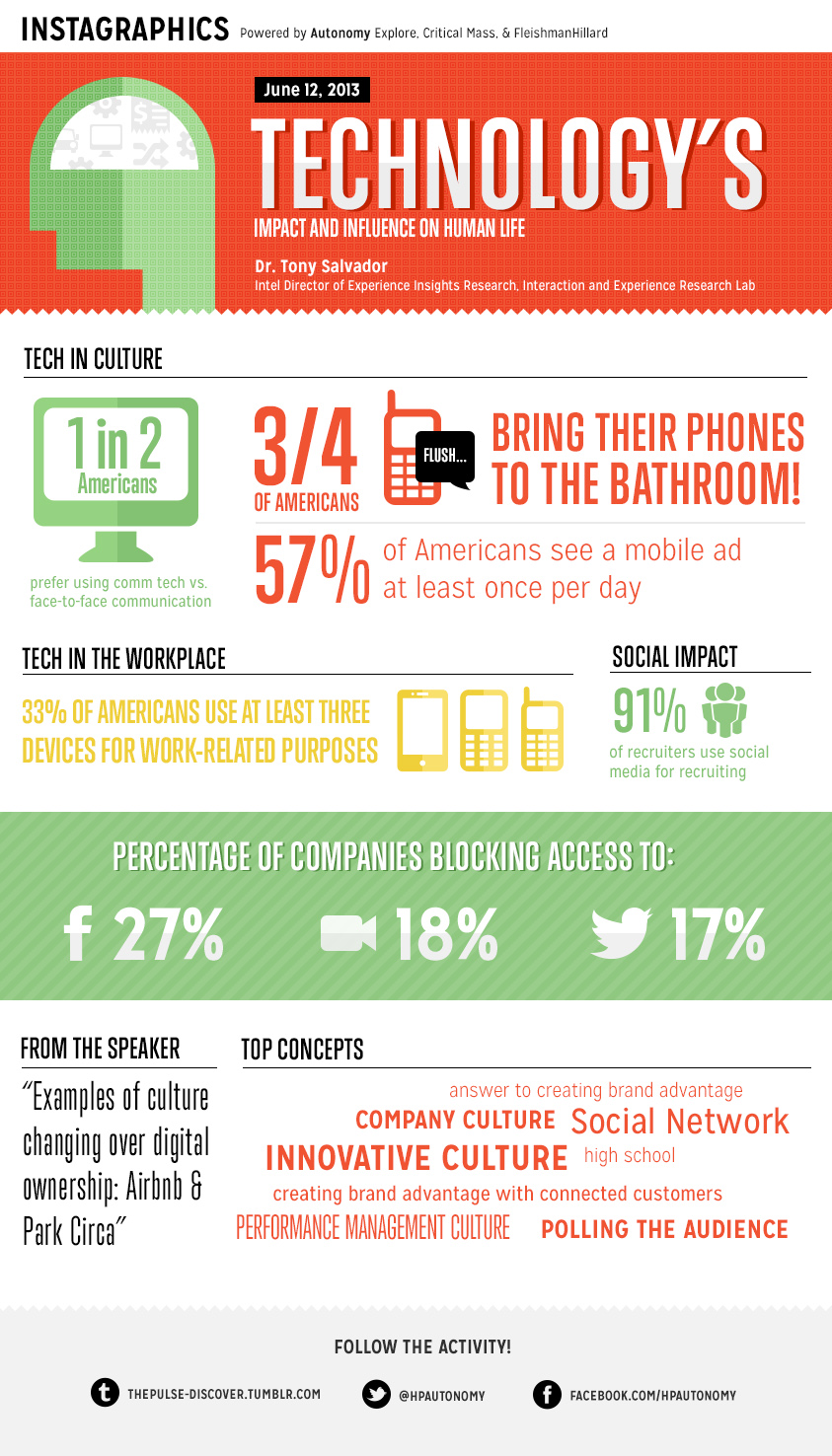
According to an infographic that went out on the second day of the conference, one in two Americans would rather use communications technology to interact with peers than have a face-to-face conversation. 75 percent bring their phones to the bathroom, and 57 percent encounter at least one mobile ad every day.

The same chart shows that one third of Americans use at least three devices for work-related purposes, and 91 percent of recruiters use social media to find potential candidates. Surprisingly, only 27 percent of companies block Facebook, 18 percent prevent employees from watching videos on YouTube, and a mere 17 percent deny their workers access to Twitter.

The Internet of Things has become a reality for both consumers and enterprises. Today, CIOs are in hot pursuit of technologies that can help their organizations transform growing quantities of sensory data into tangible business value. Nick Illyadis, the Chief Technology Officer of Broadcom, shared his insights into this trend in a recent interview with SiliconAngle founder John Furrier and Wikibon’s Jeff Kelly. He explained that software-defined networking and analytics are what make it all possible:

“You have this wireless infrastructure that can reach out and pull this information in, but then you need the network fabric behind it to be able to bring it to where it needs to go to be processed,” Illyadis said. “There’s also an angle that says, we want to filter how much of that data gets to the core, because a lot of it is redundant. So you want to have [an] intelligence engine.”


via SiliconANGLE.

[amzn_product_inline asin=’B009GDHYPQ’]

[amzn_product_inline asin=’B007005364′]

[amzn_product_inline asin=’B004150PJG’]

Filed Under: Featured Content, News, Tech Talk

Warning: iPhones Can Auto-Connect to Rogue Wi-Fi Networks

2013-06-20

Warning: iPhones can auto-connect to rogue Wi-Fi networks - QTOOTH

Security researchers say they’ve uncovered a weakness in some iPhones that makes it easier to force nearby users to connect to Wi-Fi networks that steal passwords or perform other nefarious deeds.

The weakness is contained in configuration settings installed by AT&T, Vodafone, and more than a dozen other carriers that give the phones voice and Internet services, according to a blog post published Wednesday. Settings for AT&T iPhones, for instance, frequently instruct the devices to automatically connect to a Wi-Fi network called attwifi when the signal becomes available. Carriers make the Wi-Fi signals available in public places as a service to help subscribers get Internet connections that are fast and reliable. Attackers can take advantage of this behavior by setting up their own rogue Wi-Fi networks with the same names and then collecting sensitive data as it passes through their routers.

“The takeaway is clear,” the researchers from mobile phone security provider Skycure wrote. “Setting up such Wi-Fi networks would initiate an automatic attack on nearby customers of the carrier, even if they are using an out-of-the-box iOS device that never connected to any Wi-Fi network.”

The researchers said they tested their hypothesis by setting up several Wi-Fi networks in public areas that used the same SSIDs as official carrier networks. During a test at a restaurant in Tel Aviv, Israel on Tuesday, 60 people connected to an imposter network in the first minute, Adi Sharabani, Skycure’s CEO and cofounder, told Ars in an e-mail. During a presentation on Wednesday at the International Cyber Security Conference, the Skycure researchers set up a network that 448 people connected to during a two-and-a-half-hour period. The researchers didn’t expose people to any attacks during the experiments; they just showed how easy it was for them to connect to networks without knowing they had no affiliation to the carrier.

Sharabani said the settings that cause AT&T iPhones to automatically connect to certain networks can be found in the device’s profile.mobileconfig file. It’s not clear if phones from other carriers also store their configurations in the same location or somewhere else.

“Moreover, even if you take another iOS device and put an AT&T sim in it, the network will be automatically defined, and you’ll get the same behavior,” he said. He said smartphones running Google’s Android operating system don’t behave the same way.

Once attackers have forced a device to connect to a rogue network, they can run exploit software that bypasses the secure sockets layer Web encryption. From there, attackers can perform man-in-the-middle (MitM) attacks that allow them to observe passwords in transit and even forge links and other content on the websites users are visiting.

The most effective way to prevent iPhones from connecting to networks without the user’s knowledge is to turn off Wi-Fi whenever it’s not needed. Apps are also available that give users control over what SSIDs an iPhone will and won’t connect to. It’s unclear how iPhones running the upcoming iOS 7 will behave. As Ars reported Monday, Apple’s newest OS will support the Wi-Fi Alliance’s Hotspot 2.0 specification, which is designed to allow devices to hop from one Wi-Fi hotspot to another.

Given how easy it for attackers to abuse Wi-Fi weaknesses, the Skycure research isn’t particularly shocking. Still, the ability of iPhones to connect to networks for the first time without requiring users to take explicit actions could be problematic, said Robert Graham, an independent security researcher who reviewed the Skycure blog post.

“A lot of apps still send stuff in the clear, and other apps don’t check the SSL certificate chain properly, meaning that Wi-Fi MitM is a huge problem,” said Graham, who is CEO of Errata Security. “That your phone comes pre-pwnable without your actions is a bad thing. Devices should come secure by default, not pwnable by default.”

via Ars Technica.

[amzn_product_inline asin=’B00C63PL62′]

[amzn_product_inline asin=’B00DV81YIA’]

[amzn_product_inline asin=’B00B8M4IMK’]

Filed Under: How To Tips, Mobile, News, Tech Talk

iOS 7 Massively Expands Bluetooth Support for Smartwatches, Fitness Trackers, Other Devices

2013-06-17

Using a Pebble or any other smartwatch alongside iOS isn’t nearly as convenient or user-friendly as it should be, but thankfully Apple plans on fixing that come fall. As part of iOS 7 (and OS X Mavericks), the company is greatly broadening its support for Bluetooth, a huge boon for smartwatches, fitness trackers, medical devices, and other products based around the technology.

“Less will be needed of the user”

In a post at the official Bluetooth blog, chief marketing officer Suke Jawanda outlines some of these changes. First, he confirms that Bluetooth Smart is a big part of AirDrop, an iOS 7 feature that lets nearby users quickly exchange photos and documents. With the new operating systems, Bluetooth hardware will also gain access to Apple Notification Center Services (ANCS), making the task of pushing notifications to smartwatches and other wearables far more seamless for developers. Rather than having to come up with clever workarounds — as Pebble had to do with iOS 6 — the expanded support ideally means users shouldn’t have to worry about fussing with settings to get things functioning properly.

iOS 7 Bluetooth Enhancements - QTOOTH


Bluetooth Smart devices will also see inclusion in iOS Preservation and Restoration services. What this means is that rather than needing to hold down a sync button on your Nike Fuelband, the fitness tracker will automatically push your stats to Nike’s iOS app in real time without requiring any user intervention — even if the app is closed. It’s equally big news for the growing number of Bluetooth-based medical devices on the market and in hospitals; patients won’t be encumbered with nearly as many special directives to ensure everything is communicating properly. As Apple has famously said in years past, it should “just work.” We’ll have to see whether Apple’s execution can live up to its promises when iOS 7 ships this fall. With Android also embracing Bluetooth Smart, Jawanda hints that we should hear more about Microsoft’s standing at Build later this month.

via The Verge.

[amzn_product_inline asin=’B0097CZBH4′]

[amzn_product_inline asin=’B004ZLV5PE’]

[amzn_product_inline asin=’B008XV7VTG’]

Filed Under: Featured Content, Mobile, News, Tech Talk

Spot Global Phone Keeps Adventurers Connected with the Power of Satellites

2013-06-15

SPOT Global Phone Brings Affordable, Superior Voice Quality to the Outdoor Recreation Market

Spot Global Phone - QTOOTH

Portable, easy-to-use and affordable, the new SPOT Global Phone keeps users connected to family, friends and emergency services when their adventures take them off the grid

Covington, LA (May 14, 2013) – SPOT LLC, a wholly owned subsidiary of Globalstar, Inc. and leader in satellite messaging and emergency notification technologies, today announced the new SPOT Global Phone, a portable, easy-to-use and data-enabled satellite phone. Hunters, hikers, boaters, off-road travelers and all outdoor enthusiasts will find that SPOT Global Phone provides industry-leading, crystal clear voice quality where cell service won’t work.

“Outdoor recreationists have come to appreciate SPOT as a brand that keeps them safe as they explore new ways of getting off the grid,” said Jay Monroe, Chief Executive Officer, Globalstar. “As the first satellite phone available in major retail outlets such as West Marine, REI and Cabela’s, SPOT Global Phone will not only provide a lifeline during these adventures, but an opportunity to connect with impeccably clear voice quality on a satellite network that is light years ahead of the competition.”

  • SPOT Global Phone Features
  • Compact size: 5.3″H x 2.2″ W x 1.5″D
  • Lightweight: 7 ounces
  • Satellite-based technology
  • Superior voice clarity with no noticeable delay or echo
  • Backlit color display optimized for outdoor daytime viewing
  • Long-life battery: 4 hours talk time, 36 hours standby
  • Data capable enabling email and file transfers
  • Quick online activation, ten-digit dialing with local phone numbers
  • Ergonomic design
  • Lighted keypad
  • 911 emergency service access

SPOT Global Phone ensures users can connect with family, friends and businesses even when their adventures take them out of cell coverage. With patented Qualcomm-based CDMA technology providing crystal-clear voice quality from anywhere within the service footprint, SPOT Global Phone users experience superior performance. Critical communications happen in an instant, with no noticeable time delays on a network that transmits even a whisper. With the availability of Express Data on most data plans, guaranteed data speeds of 9.6Kbps provide up to four times the data speed of most other mobile satellite data services and enable emails, file transfers, and basic services to occur at high-speed.

[amzn_product_inline asin=’B00CU9Z88S’]

[amzn_product_inline asin=’B00BX7TJ2O’]

[amzn_product_inline asin=’B008RYYESU’]

Filed Under: Mobile, News, Tech Talk

  • « Go to Previous Page
  • Page 1
  • Interim pages omitted …
  • Page 6
  • Page 7
  • Page 8
  • Page 9
  • Page 10
  • Go to Next Page »

Primary Sidebar

Affiliate Disclosure

This website uses affiliate programs for monetization. At no additional cost to you, links to various sites mentioned in posts may result in a commission that is credited to this site if you make a purchase.

Some affiliate programs and affiliations include, but are not limited to, Commission Junction, Apple, Google, Amazon.com and more.

For complete details
click here.

Copyright © 2026 · Preferred Hosting by WP Engine and Domain Name Registry by Namecheap

We are using cookies to give you the best experience on our website.

You can find out more about which cookies we are using or switch them off in .

QTOOTH
Powered by  GDPR Cookie Compliance
Privacy Overview

This website uses cookies so that we can provide you with the best user experience possible. Cookie information is stored in your browser and performs functions such as recognising you when you return to our website and helping our team to understand which sections of the website you find most interesting and useful.

Strictly Necessary Cookies

Strictly Necessary Cookie should be enabled at all times so that we can save your preferences for cookie settings.

3rd Party Cookies

This website uses Google Analytics to collect anonymous information such as the number of visitors to the site, and the most popular pages.

Keeping this cookie enabled helps us to improve our website.

Additional Cookies

This website uses the following additional cookies:

(List the cookies that you are using on the website here.)