• Skip to primary navigation
  • Skip to main content
  • Skip to primary sidebar

QTOOTH

News & Reviews for Living with Bluetooth Wireless

  • Reviews
    • Wearable
    • Gaming
    • Health & Fitness
    • Home & Office
  • How To Tips
  • Industry News
  • About QTOOTH

Transportation

Hitting the Right Frequency: Review of the LENCENT FM Transmitter

2024-01-30

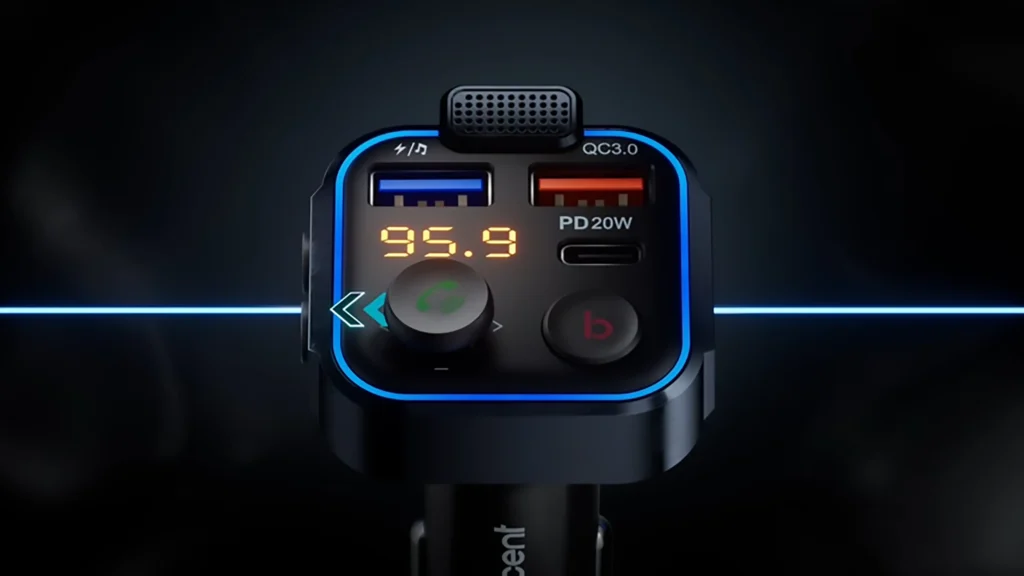
Let’s face it, most stock car stereos feel stuck in a time warp. Sure, they might play the radio, but Bluetooth connectivity and hands-free calling are often luxuries reserved for newer models. That’s where gadgets like the LENCENT FM Transmitter come in, promising to bridge the gap between your old-school stereo and your smartphone’s modern music haven. I’ve been test-driving this little adapter for the past few weeks, blasting beats and chatting hands-free on my daily commute, and I’m here to share my unfiltered verdict.
First Impressions:

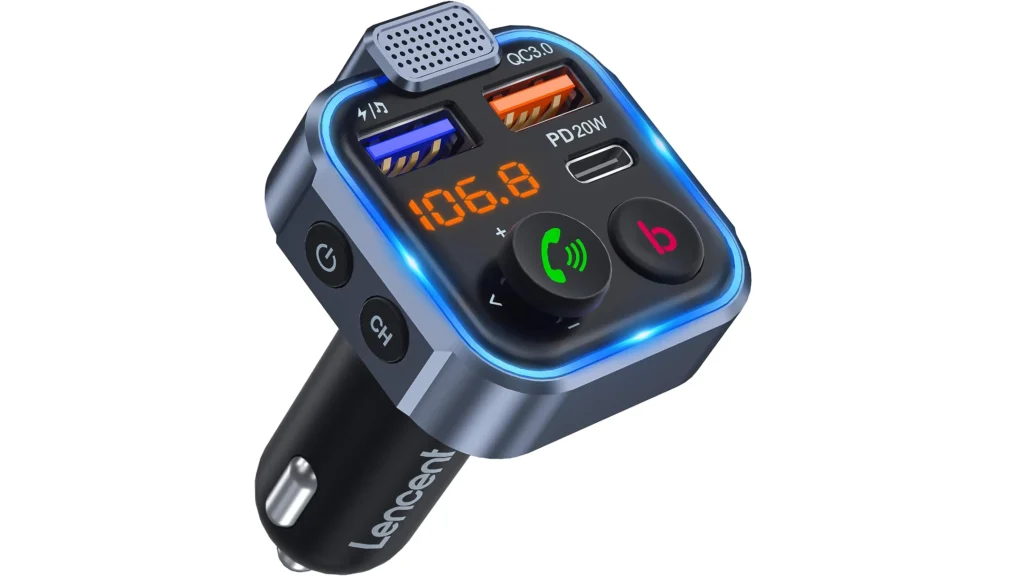
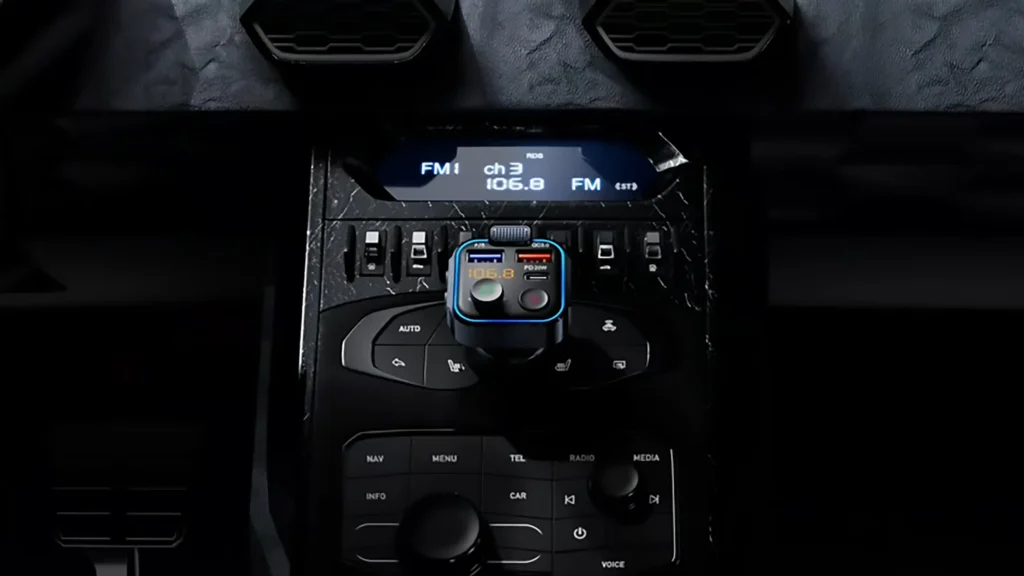
Plugging the LENCENT into my cigarette lighter was as effortless as it gets. The swivel design lets you adjust the angle for optimal placement, and the LED display is bright and clear, even in direct sunlight. Setting up the Bluetooth connection was a breeze – just pair it with your phone like any other wireless device, and you’re good to go.
Pros:

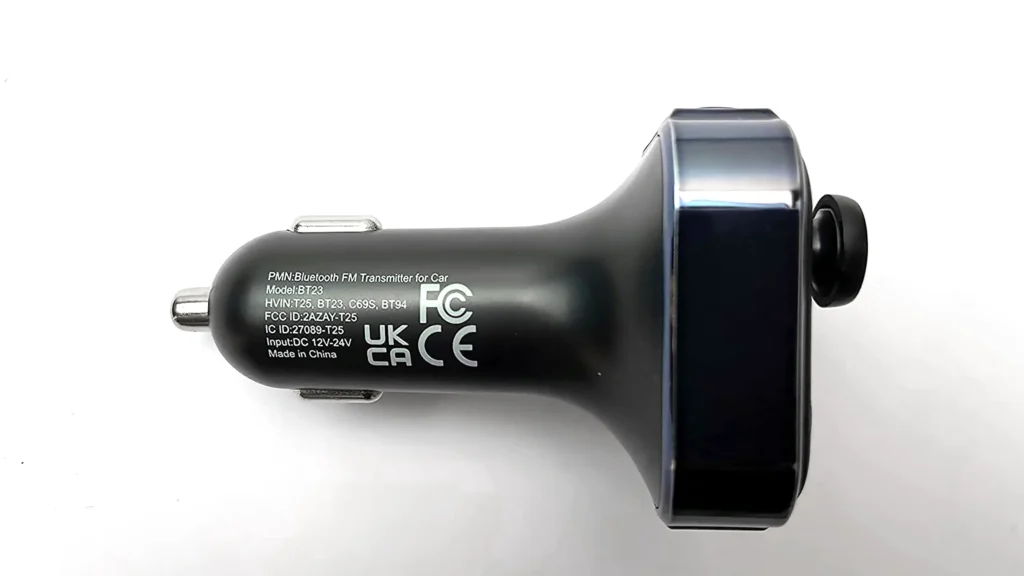
  • Wireless Nirvana: Gone are the days of fumbling with aux cords. Connecting via Bluetooth 5.0 was seamless, offering a rock-solid connection throughout my drives. Music streamed flawlessly, and calls came through without a hitch. The range was impressive too, staying connected even when I ventured into parking lots or underground garages.
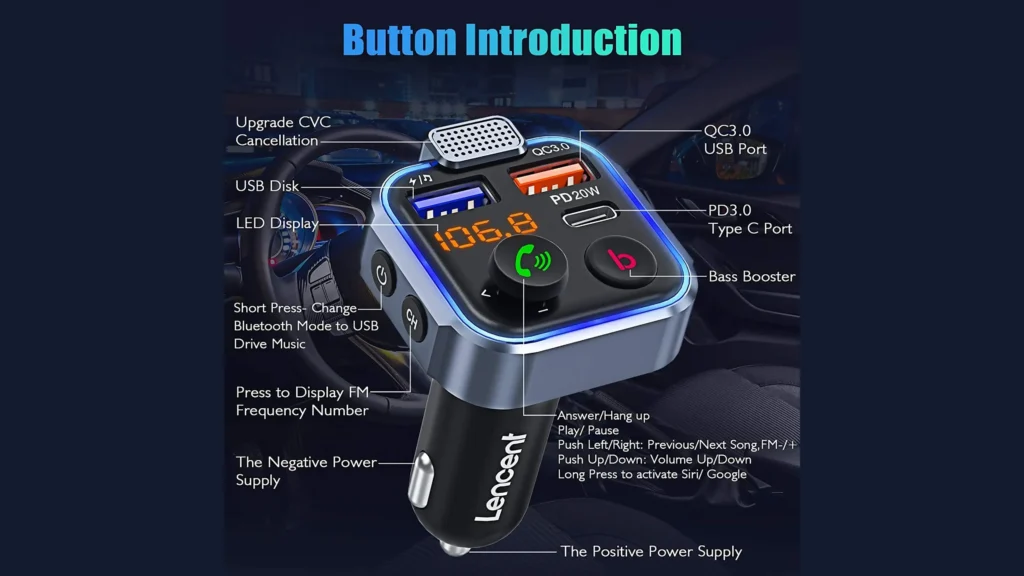
  • Dual Charging Dynasty: This little adapter isn’t just about tunes; it’s a charging powerhouse. With a Type-C PD 20W port and a QC3.0 USB port, I could juice up my phone and tablet simultaneously at breakneck speeds. No more choosing between blasting Spotify or keeping my GPS alive – the LENCENT kept both devices fueled for the journey.
  • Crystal Clear Conversations: Hands-free calling was surprisingly good. The built-in microphone picked up my voice clearly, even with some road noise. Callers on the other end reported hearing me loud and crisp, a welcome change from the crackly, garbled experience of most car speakers.

Cons:

  • Frequency Frenzy: Finding a clear FM frequency was a bit of a chore. City driving meant encountering several occupied channels, forcing me to hop around the dial until I landed on a static-free zone. This wasn’t a deal-breaker, but it did add a few extra minutes to my pre-drive routine.
  • Bass Bump Blues: While the audio quality was generally good, bass lovers might be left wanting. The sound leaned towards the treble-heavy side, and even cranking the bass boost button didn’t quite deliver the deep thump I crave.
  • Gadget Overload: The LENCENT does its job admirably, but it adds another chunk of plastic to an already cluttered dashboard. If you’re minimalista in your car aesthetics, the extra gadget might not be your cup of tea.
The Verdict:

Overall, the LENCENT FM Transmitter is a solid upgrade for cars lacking built-in Bluetooth and fast charging. The wireless connectivity, crystal-clear calls, and dual charging ports make it a compelling option for anyone who wants to modernize their driving experience. While the finicky frequency selection and slightly thin sound might deter audiophiles, for the average music lover and phone-addicted driver, the LENCENT is a worthwhile investment. It’s transformed my car from a tech relic to a connected haven, keeping the tunes flowing and my devices juiced up for every adventure.

Would I recommend it? Absolutely. If you’re looking for an affordable way to breathe new life into your car’s audio system and keep your devices powered up, the LENCENT FM Transmitter definitely hits the right frequency.
Final Score: 4 out of 5 stars

I hope this honest review helps you decide if the LENCENT FM Transmitter is the right copilot for your next road trip. Happy driving!

Filed Under: Featured Content, Reviews, Transportation

Dialog Semiconductor Extends its Bluetooth® Low Energy Market Success to Automotive Tire Pressure Monitoring Systems

2017-09-14

London, United Kingdom – September 13, 2017 – Dialog Semiconductor plc (XETRA:DLG), a provider of highly integrated power management, AC/DC power conversion, charging, and connectivity technology, today announced the first shipments of its SmartBond™ DA14585 Bluetooth low energy (BLE) System-on-Chip (SoC) to two internationally-recognized suppliers to the automotive industry for use in tire pressure monitoring system (TPMS) sensors. With over 100 million units of its SmartBond SoCs already shipped to other applications, this represents another success milestone for Dialog’s Bluetooth market leadership.

A TPMS sensor is an electronic subsystem for monitoring the air pressure and temperature within automobile tires, alerting drivers of improperly-inflated tires or other safety information in real time. Most typical TPMS sensors use proprietary or non-standard sub-GHz radios to transfer information to the automobile’s computer, but by replacing these radios with Bluetooth low energy connectivity, TPMS can now take advantage of a worldwide standard and the interoperability it brings with the added benefit of long battery lifetime and smartphone connectivity.

With a long legacy in the automotive market as a provider of motor control ICs, Dialog now addresses the TPMS market with the DA14585, the lowest cost, lowest power Bluetooth low energy SoC in high volume production today. To build a Bluetooth low energy-enabled TPMS, only sensors supporting pressure, temperature and acceleration and a battery need to be added. The DA14585 handles the entire processing required for the TPMS application, with no additional microcontroller needed. Further benefits include high security, upgradable firmware and connectivity to automobile computers via a single node for all Bluetooth low energy functions.

“TPMS is already mandated in the United States, South Korea, and the European Union,” said Sean McGrath, SVP and GM of the Connectivity, Automotive and Industrial Business Unit, Dialog Semiconductor. “With other countries such as China and Japan reviewing their own mandates, the early adoption of Bluetooth low energy for TPMS represents an excellent opportunity for Dialog to support the automotive market’s move into the next phase of connectivity and also address the rapidly-growing TPMS aftermarket with these first design wins.”

The DA14585 is available for purchase through Avnet, Digi-Key and Mouser Electronics. As with all SmartBond solutions, the DA14585 is easy to design with, and supports standalone as well as hosted applications. It is supported by a complete development environment including Dialog SmartSnippets™ software, helping designers profile and fine tune the power consumption of their applications. For more information on the DA14585 and Dialog’s Bluetooth SmartBond technology, visit: https://www.dialog-semiconductor.com/bluetooth-low-energy

Filed Under: IoT, News, Tech Talk, Transportation

FAA Changes Guidelines Allowing More Use of Wireless Devices on Airplanes

2013-11-04

faa-changes-electronic-device-use-restrictions-qtooth

We’ve all been wondering for years whether it really makes a difference to our safety, but the FAA is finally starting to make changes to their guidelines and are going to start allowing more use of wireless devices and electronics on Airplanes. We’ve even heard from some of our strategically placed friends (i.e. pilots and flight attendants) that what they really want is not for the device to be off but rather that they have our undivided attention should things get “interesting”. However there seems to be some relaxing of the current restrictions according to the FAA, which oversees air travel announced on Thursday.

What this does not mean is that you can just go crazy and use all of your electronic devices all of the time. The changes in the restrictions may vary depending on the airline. This is because there are differences between types of planes and how things are run at each different carrier. The FAA does anticipate that most airlines will permit passengers to use their devices “in airplane mode, gate-to-gate, by the end of the year.”

The word is that passengers can use e-book readers, play games and watch videos on devices, and can either hold gadgets or else stow them in the seat back pocket during both take-off and landing. And even though these devices are required to be in Airplane Mode or have cell service turned off during both landing and taxi/take-off, you can actually use Wi-Fi during your flight and continue to use any Bluetooth accessories connected to your phone.

Here are some quick guidelines that the FAA says travelers need to be aware of in order to make sure they’re still covered under these most recent changes:

1. Make safety your first priority.

2.  Changes to PED policies will not happen immediately and will vary by airline. Check with your airline to see if and when you can use your PED.

3.  Current PED policies remain in effect until an airline completes a safety assessment, gets FAA approval, and changes its PED policy.

4. Cell phones may not be used for voice communications.

5.  Devices must be used in airplane mode or with the cellular connection disabled. You may use the WiFi connection on your device if the plane has an installed WiFi system and the airline allows its use.  You can also continue to use short-range Bluetooth accessories, like wireless keyboards.

6. Properly stow heavier devices under seats or in the overhead bins during takeoff and landing. These items could impede evacuation of an aircraft or may injure you or someone else in the event of turbulence or an accident.

7. During the safety briefing, put down electronic devices, books and newspapers and listen to the crewmember’s instructions.

8.  It only takes a few minutes to secure items according to the crew’s instructions during takeoff and landing.

9.  In some instances of low visibility – about one percent of flights – some landing systems may not be proved PED tolerant, so you may be asked to turn off your device.

10. Always follow crew instructions and immediately turn off your device if asked.

We’re glad to see the FAA is being considerate in adjusting itself to changing realities. Most of us would prefer a little inconvenience over any compromised safety, but some of the restrictions did seem arbitrary. Now, where were we in our in-flight entertainment….

[amzn_product_inline asin=’B0054JJ0QW’]

[amzn_product_inline asin=’B007K5BY08′]

[amzn_product_inline asin=’B00AVLOHJ8′]

Filed Under: News, Transportation

Borqs Focuses on the Road Weary with Smart Vehicle Mounted Terminals

2013-06-27

borqs-smart-vehicle-mounted-terminals-qtoothIntimidated by road-trip getaways? Overwhelmed by boredom while driving? Like to work on-the-move but can’t access your office computer from your car? Well, quit worrying, because vehicle-mounted terminals are finally here! Boasting user-focused interactive features, these smart devices are designed to completely satisfy drivers’ demands in the modern age. What’s more, Borqs believes that their advances are sure to bring about an entirely new driving experience and radically change car culture.

In 2012, 15.495 million passenger vehicles (cars, SUVs, and others) were sold in China, a growth rate of 7.1 percent from the previous year. An EnfoDesk report titled “The Quarterly Report of China’s Pre-installed Vehicle Navigator Market” revealed that shipments of before-market vehicle navigation systems had increased dramatically during the 2nd quarter of 2012 to 361,000 units in total. This represented an increase of 22.9 percent over the previous year. In the 4th quarter, this number rose further to 342,000 units, an increase of 9.3 percent over the previous quarter. Additionally, the after-market demand for commercial vehicle navigation systems is also rising by the day.

Customer demands in this large market are becoming more complex. On a driving holiday, car owners want to be able to simultaneously change destinations, check out local geography and weather conditions, enjoy unrestricted videophone calls and high-speed web browsing, watch HD video on demand, play online 3D games, interact via voice, and use other data-intensive interactive applications. The Borqs Smart Vehicle Mounted Platform meets all of these demands.

Borqs has redesigned Android for vehicles, and the result is an open, flexible, and secure vehicle-mounted OS that leverages satellite positioning and inertial navigation technology provided by Beidou. Borqs’ sophisticated systems also rely on network-assisted positioning technologies, guaranteeing accurate full-time navigation services across any and all topographies. TD-LTE also integrates a high-speed wireless data cloud, providing users with dynamic and intelligent navigation services. And thanks to the accurate positioning services and real-time data provided by Beidou and TD-LTE, Borqs’ Smart Background Vehicle Management System makes it easy to simultaneously monitor, supervise, and dispatch up to two passenger vehicles and one hazardous cargo vehicle, all in real time.

The Borqs Smart Vehicle Mounted Terminal uses Android 4.1, offering a feature-rich UI with simplified workflows, all adapted to the specialized habits of customers. The device is also future compatible, supporting mobile internet technologies such as HTML5 and IPv6. And Borqs has also expanded platform functionality to include cloud computing and safety control features. For our Smart Vehicle Mounted System, Borqs has collaborated with many of China’s premier car manufacturers, including FAW, Chang’an Automobiles, the GAC Group, and GEELY, providing customers with vehicle-mounted communication, recorded media entertainment, information services, route guidance, safety assistance, and car maintenance tips for vehicle monitoring, navigation, and entertainment.

via Smart Vehicle Mounted Terminals: For an Entirely New Way of Life — CUPERTINO, Calif., June 28, 2013 /PRNewswire/ —.

[amzn_product_inline asin=’B00BV1NKCW’]

[amzn_product_inline asin=’B00BW0XZO0′]

[amzn_product_inline asin=’B009SK57ZQ’]

Filed Under: Mobile, Tech Talk, Transportation

Wireless Service for 30 New Underground Subway Stations

2013-06-24

nyc-skyline-qtoothTransit Wireless and the Metropolitan Transportation Authority (MTA)  announced a significant milestone in the multi-year project to build a state of the art wireless network in the New York City subway system. Thirty new subway stations in mid-town Manhattan, including Times Square, Rockefeller Center, Lincoln Center and Columbus Circle are now online, in addition to the initial six in Chelsea, which went online in September 2011.

MTA officials were joined by executives from Transit Wireless, AT&T, T-Mobile USA and Boingo Wireless to demonstrate the service at the Times Square Station.

In addition, representatives from Sprint and Verizon Wireless were also on hand to announce that both carriers are finalizing agreements to participate in the network, meaning that all four major carriers are expected to provide cell phone and data connectivity to their customers in New York’s underground subway stations.

“For the past three years, the MTA has been on a clearly defined mission to bring our mass transit system into the 21st century with upgrades to the station environment through several ambitious new-technology communications projects like this one, aimed at improving the travel experiences of our customers while offering another level of security,” said MTA Interim Executive Director Thomas F. Prendergast.”

“The New York City subway system is the most heavily trafficked system in the world and now riders have wireless service. We have been working closely with AT&T, T-Mobile USA and Boingo to bring wireless technology into one of the oldest and historic public transportation systems in the world and we’re thrilled to begin that work with Sprint and Verizon,” said William A. Bayne Jr., CEO of Transit Wireless, “This network benefits not only riders, but city workers and first responders, and it will be the backbone for future technology and safety improvements to the city’s subway stations.”

Public Safety Benefits

grand-central-qtoothWhile the network allows users to make and receive cell phone calls, send text messages, stream music, play online mobile games and more, all from underground subway station, it also enables important services that improve security such as E911 that allow dispatchers to know when a call is being placed from an underground platform and the forthcoming Help Point Intercom system, which will help riders get basic travel information or get help in an emergency with the push of a button, right on the platform.

“This goes beyond providing cell service underground, it brings our customers a new level of security – with the ability to dial 911 in an emergency,” said Acting MTA Chairman Fernando Ferrer. “Customers now know that when they see something, they can now say something using their device to call 911.”

Leading Wireless Providers Continue Partnership

Under agreements with the MTA and Transit Wireless, AT&T and T-Mobile USA customers can now use their cell phones to make and receive calls as well as use wireless data in more underground subway stations. Service should be available for Sprint and Verizon customers later this year.

“Bringing wireless to these busy subway platforms helps AT&T deliver on its commitment to provide our customers with the fastest and most reliable wireless service in New York City, including 4G LTE, whether above or below ground, at home, at work or in between,” said Tom DeVito, AT&T’s vice president and general manager for New York and New Jersey. “This initiative will also help spur transit innovation, which is one of the reasons AT&T is working with the MTA and NYU Poly on the AppQuest Challenge to develop the next generation of transit apps to improve the experience of every commuter.”

“Through this project, T-Mobile is extending our blazing fast nationwide 4G network coverage into the New York City subway, where New Yorkers often spend a significant part of the day,” said Tom Ellefson, regional vice president, Engineering and Operations at T-Mobile USA. “Our customers have really embraced the unlimited 4G experience T-Mobile offers, and now they can keep browsing, streaming and sharing when they go underground. We expect to launch 4G LTE in New York this summer, and this project has paved the way for it to extend into the subway as well.”

“Boingo has kept commuters connected since our managed and operated services launched in 2011. We look forward to expanding our network and introducing leading brands to consumers at stations across the city,” said Zack Sterngold, vice president of business development at Boingo Wireless. “Boingo’s advertising and sponsorship platform allows commuters to connect to subway Wi-Fi free-of-charge, and enables advertisers to reach the on-the-go, connected New Yorkers with location-based messages.”

Subway riders can currently access the sponsored Wi-Fi network provided by Boingo for free by choosing the SSID: FreeWifibyHTCONE.

“In the city that never sleeps, New Yorkers love to use their mobile devices 24/7 to stay connected to friends, loved ones and business associates. So, we are thrilled to include the subway in the buildout of our new network and deliver the robust benefits of 3G and 4G LTE to commuters, public safety representatives and first responders,” said Greg O’Connor, vice president of engineering at Sprint.

“Verizon Wireless is always exploring opportunities to provide our customers with the world-class experience of the nation’s largest 4G LTE network and most reliable 3G network, no matter where they are – above ground or below. In addition to the more than $3 billion that we’ve already invested in the Verizon Wireless network regionally, we’re working with Transit Wireless to finalize an agreement to bring Verizon Wireless service to 76 stations as we support the current and next phase of this project,” said Patrick Devlin, regional president for Verizon Wireless.

The list of stations now connected is as follows (* first six were part of the initial build):

*123 Street – 8 Ave.CE
*214 Street – 8 Ave.ACE
*314 Street – 7 Ave.123
*414 Street – 6 Ave.FM
*514 Street – 8 Ave.L
*614 Street – 6 Ave.L
796 StreetBC
886 StreetBC
928 Street1
1018 Street1
1181 Street-Museum of Natural HistoryBC
1272 StreetBC
1379 Street1
1423 Street1
1596 Street123
1666 Street-Lincoln Center1
1772 Street123
1857 StreetF
1947-50 Streets-Rockefeller CenterBDFM
2057 Street-7 Ave.NQR
2128 StreetNR
2250 Street1
2350 StreetCE
2423 StreetNR
2549 StreetNR
265 Ave.-53 StreetEM
2759 Street-Columbus Circle1
2859 St-Columbus CircleABCD
297 Ave.BDE
30Times Square-42 Street123
31Times Square-42 StreetNQR
32Times Square-42 Street7
33Times Square-42 StreetACE
34Times Square-42 StreetS
355 Ave.-59 StreetNR
3686 Street1


To quickly find stations that have wireless service, Transit Wireless today released a mobile-friendly website, available now at www.nycsubwaywireless.com.

Transit Wireless plans to outfit the remaining 241 underground stations within four years and has already begun work on the next 40 stations, which include Grand Central Station, 34th St. Herald Square and Bryant Park in mid-town Manhattan and stations throughout the Borough of Queens.

[amzn_product_inline asin=’B007OZNZG0′]

[amzn_product_inline asin=’B0083PWAPW’]

[amzn_product_inline asin=’B0051QVESA’]

Filed Under: Featured Content, Mobile, News, Tech Talk, Transportation

Hands-Free Gadgets Don’t Mean Risk-Free Driving

2013-06-12

Hands-Free Study: Driving - QTOOTHThis story comes to us from NPR’s Shots Health News Desk. We here at QTOOTH feel that technology needs to be MORE transparent in our lives. It is our belief that this can happen through the use of low-power wireless devices. We don’t have any problem with these studies at all. To us it just means that more work needs to be done so that operating our devices while engaged in another activity, like driving, can be done as safely as listening to the radio (an example given in the study). We’d love to get your feedback on your thoughts and feelings about the subject. Please comment below or contact us directly. Here’s the story:

If you’ve felt smug and safe using built-in, voice-controlled technology for text messages, email and phone calls while driving, forget it. There are some sobering findings about the risk of distraction from the American Automobile Association and the University of Utah.

“ Don’t assume that if your eyes are on the road and your hands are on the wheel that you are unimpaired.

– Prof. David Strayer

The proliferation of hands-free technology “is a looming public safety crisis,” AAA CEO Robert Darbelnet says. “It’s time to consider limiting new and potentially dangerous mental distractions built into cars.”

AAA commissioned a study by a that has focused on distracted driving. The report can be found .

“These new, speech-based technologies in the car can overload the driver’s attention and impair their ability to drive safely,” says psychology professor . “Don’t assume that if your eyes are on the road and your hands are on the wheel that you are unimpaired.”

Strayer and his team tracked eye and head movements, charted brain activity and measured driver reaction time while test drivers in simulators and on the road listened to the car radio, talked on a cellphone (both handheld and hands-free) or listened to and responded to voice-activated email features.

“We found that interacting with the speech-to-text system was the most cognitively distracting,” Strayer reports.

Voice-activated features “increased mental workload and distraction levels” and heightened risk, says Peter Kissinger of the AAA Foundation for Traffic Safety, which funded the study. Test drivers experienced “a type of tunnel vision or inattention blindness where motorists don’t see potential hazards right in front of them,” he says.

Driving simulator in University of Utah’s Applied Cognition Laboratory

Strayer says that “an unintended consequence of trying to make driving safer — by moving to speech-to-text, in-vehicle systems — may actually overload the driver and make them less safe.”

Maybe you can find that creative spark out in Zion National Park in southwestern Utah.

AAA urges the electronics and auto industry to limit voice-activated technology to “core driving-related activities, such as climate control, windshield wipers and cruise control.” The group wants car companies to disable voice-to-text email, texting and social media while driving.

The prefers to wait for other academic studies so that “a complete body of research” drives policy, spokesman Wade Newton says.

“We will need to review the AAA/University of Utah study, but we are extremely concerned that it could send a misleading message since it suggests that hand-held and hands-free devices are equally risky,” Newton says. “The AAA study focuses only on the cognitive aspects of using a device, and ignores the visual and manual aspects of hand-held versus integrated hands-free systems.”

The most distracting task for test drivers in the study involved remembering words while solving math problems while driving. The researchers don’t actually believe that’s a real-world problem. It’s what they came up with to provide a benchmark for the most severe distracted driver reactions.

In you case you were wondering, the researchers took care to make sure that the drivers they were distracting weren’t in danger. The cars used in road tests were outfitted with redundant brakes that researchers riding along could use, if necessary. They also could warn drivers about imminent hazards.

via Hands-Free Gadgets Don’t Mean Risk-Free Driving : Shots – Health News : NPR.

[amzn_product_inline asin=’B0043M668G’]

[amzn_product_inline asin=’B004ULOZRY’]

[amzn_product_inline asin=’B004URRR0U’]

Filed Under: News, Transportation

Primary Sidebar

Affiliate Disclosure

This website uses affiliate programs for monetization. At no additional cost to you, links to various sites mentioned in posts may result in a commission that is credited to this site if you make a purchase.

Some affiliate programs and affiliations include, but are not limited to, Commission Junction, Apple, Google, Amazon.com and more.

For complete details
click here.

Copyright © 2026 · Preferred Hosting by WP Engine and Domain Name Registry by Namecheap

We are using cookies to give you the best experience on our website.

You can find out more about which cookies we are using or switch them off in .

QTOOTH
Powered by  GDPR Cookie Compliance
Privacy Overview

This website uses cookies so that we can provide you with the best user experience possible. Cookie information is stored in your browser and performs functions such as recognising you when you return to our website and helping our team to understand which sections of the website you find most interesting and useful.

Strictly Necessary Cookies

Strictly Necessary Cookie should be enabled at all times so that we can save your preferences for cookie settings.

3rd Party Cookies

This website uses Google Analytics to collect anonymous information such as the number of visitors to the site, and the most popular pages.

Keeping this cookie enabled helps us to improve our website.

Additional Cookies

This website uses the following additional cookies:

(List the cookies that you are using on the website here.)